May 20, 2026

ERW vs Seamless Pipe
Jindal pipes

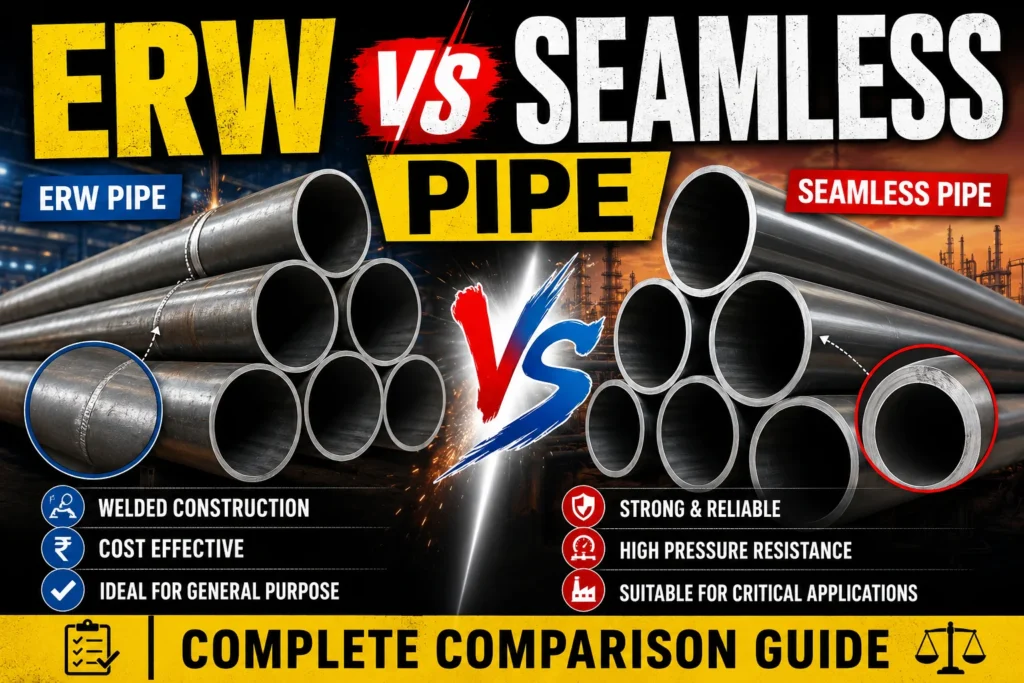
ERW vs Seamless Pipe – Complete Comparison Guide

ERW vs Seamless Pipe – Complete Comparison Guide ERW pipes and seamless pipes differ mainly in their manufacturing process, strength, pressure handling, and industrial applications. ERW pipes are welded and cost-effective for general construction and plumbing, while seamless pipes are stronger, pressure-resistant, and preferred for oil, gas, boiler, and high-temperature industrial applications. Selecting the right industrial pipe is one of the most important decisions in any construction, fabrication, plumbing, or industrial project. Many buyers, contractors, EPC companies, fabrication industries, refineries, and plumbing contractors often get confused between ERW pipes and seamless pipes because both are widely used across industries. However, the wrong pipe selection can directly affect: Project safety Pressure handling capability Maintenance cost Corrosion resistance Long-term durability Overall project lifespan In industrial applications, choosing between ERW and seamless pipes is not only about price. It is also about operating pressure, temperature conditions, mechanical strength, and reliability. This detailed industrial pipe comparison guide explains the complete difference between ERW and seamless pipe, including manufacturing process, applications, advantages, disadvantages, pricing, strength, weight, and industrial suitability. What is ERW Pipe? ERW pipe full form is Electric Resistance Welded Pipe. These pipes are manufactured by rolling steel strips or coils into a cylindrical shape and welding the edges using electric resistance heat. Unlike traditional welded pipes that use filler material, ERW pipes are welded through electrical resistance and pressure. The weld seam is heat-treated to improve strength and durability. ERW pipes are widely used because they are: Economical Easily available Dimensionally accurate Suitable for medium-pressure applications Ideal for structural and plumbing use ERW steel pipes are one of the most common carbon steel pipe types used in India and international markets. How ERW Pipes are Manufactured The manufacturing process of ERW pipes involves several high-speed production stages. 1. HR Coil Preparation The process starts with Hot Rolled (HR) steel coils. These coils are slit into steel strips according to the required pipe size. 2. Strip Formation The steel strip passes through multiple forming rollers that gradually bend it into a round tubular shape. 3. Electric Resistance Welding Once the edges meet, high-frequency electric current generates heat at the joint. Pressure rollers then fuse the edges together without filler metal. This creates a strong longitudinal weld seam. 4. Sizing Process The welded pipe passes through sizing rollers to achieve accurate dimensions and diameter consistency. 5. Finishing After sizing, pipes undergo: Cutting Straightening Surface finishing End finishing 6. Testing and Inspection ERW pipes are tested for: Hydrostatic pressure Weld integrity Thickness Diameter tolerance Surface defects Modern ERW manufacturing provides: High production speed Excellent dimensional accuracy Smooth surface finish Consistent wall thickness Common Applications of ERW Pipes ERW steel pipe applications are extensive because of their affordability and versatility. Common uses include: Water pipelines Structural fabrication Scaffolding Plumbing systems Fencing Agricultural pipelines Furniture manufacturing Automotive components Steel structures Conveyor systems ERW pipes are highly preferred in construction and infrastructure projects due to their lower cost and easy availability. What is Seamless Pipe? A seamless pipe is a steel pipe manufactured without any welded joint or seam. These pipes are produced from solid steel billets and are known for superior mechanical strength and pressure resistance. Since there is no weld seam, seamless pipes perform better in: High-pressure conditions High-temperature applications Critical industrial systems Corrosive environments Seamless steel pipe uses are mainly found in industries where safety and reliability are extremely important. How Seamless Pipes are Manufactured The manufacturing process of seamless pipes is more complex and expensive than ERW pipes. 1. Solid Steel Billet Heating A solid round steel billet is heated at very high temperatures. 2. Rotary Piercing The heated billet is pierced using rotary piercing equipment to create a hollow center. 3. Elongation The hollow shell is elongated using rolling mills to achieve the required pipe length and diameter. 4. Rolling Process The pipe undergoes additional rolling for dimensional refinement and wall thickness control. 5. Heat Treatment Heat treatment improves: Mechanical properties Strength Hardness Pressure resistance 6. Finishing and Inspection The final stage includes: Straightening Surface finishing Ultrasonic testing Hydro testing Dimensional inspection Although seamless manufacturing is expensive, it produces pipes with: Superior mechanical properties Excellent pressure resistance Better reliability in critical applications Common Applications of Seamless Pipes Seamless steel pipes are heavily used in industries where operational failure can be dangerous. Common seamless steel pipe uses include: Oil & gas pipelines Refineries Power plants Boiler systems Petrochemical industries Hydraulic systems Chemical processing industries High-pressure steam lines Offshore drilling operations These industries prefer seamless pipes because they can withstand extreme pressure and temperature conditions. ERW vs Seamless Pipe: Key Differences Below is the complete industrial pipe comparison between ERW and seamless pipes. Feature ERW Pipe Seamless Pipe Manufacturing Welded No weld Strength Moderate Very high Pressure Handling Medium Excellent Cost Lower Higher Surface Finish Smooth Slightly rough Size Accuracy Better Moderate Availability Easily available Limited Industrial Use General Critical applications The major difference between ERW and seamless pipe lies in the presence of a welded seam. Seamless pipes offer better strength under extreme conditions, while ERW pipes provide economical solutions for general applications. Which Pipe is Stronger: ERW or Seamless? When discussing welded vs seamless pipe strength, seamless pipes are generally considered stronger. This is because seamless pipes do not contain a welded joint, eliminating the possibility of weld seam failure under high pressure. However, modern ERW manufacturing technology has significantly improved weld quality. High-quality ERW pipes today can safely perform in many medium-pressure industrial applications. The final choice depends on: Operating pressure Temperature Fluid type Safety requirement Budget Industry standards For critical industries like oil & gas or boilers, seamless pipes are usually preferred. For structural work, plumbing, and fabrication, ERW pipes are often sufficient. ERW Pipe vs Seamless Pipe Price Comparison One of the biggest deciding factors for buyers is pricing. Seamless pipes are more expensive because of: Complex manufacturing process Higher energy consumption Solid billet requirement More material wastage Lower production speed ERW pipes are comparatively economical because they are produced
Jindal SS 304 Pipe Price List 2026
Jindal pipes

Jindal SS 304 Pipe Price List 2026 – Latest Stainless Steel Pipe Rates

Jindal SS 304 Pipe Price List 2026 – Latest Stainless Steel Pipe Rates Stainless steel demand in India is continuously increasing due to rapid industrial development, infrastructure expansion, food processing growth, and rising demand for corrosion-resistant piping systems. Industries now prefer stainless steel piping because of its durability, hygienic properties, low maintenance requirements, and long operational life in harsh environments. Among all stainless steel pipe manufacturers, Jindal has become one of the most trusted names in the Indian market. From industrial process plants to pharmaceutical factories and commercial infrastructure projects, Jindal SS 304 pipes are widely used because of their premium quality standards, accurate dimensions, and reliable performance. Both ERW and seamless stainless steel pipes are available in multiple schedules, thicknesses, and finishes. However, due to fluctuations in nickel prices, chromium costs, transportation charges, and international steel demand, stainless steel pipe rates continue to change frequently. This detailed guide covers the latest Jindal SS 304 pipe price list 2026, including ERW pipe prices, seamless pipe rates, sizes, thickness charts, weight information, industrial applications, buying factors, and bulk supply guidance. If you are comparing suppliers, planning industrial procurement, or understanding stainless steel pipe specifications, this guide will help you make a better buying decision. What is Jindal SS 304 Pipe? Jindal SS 304 pipe is a high-quality austenitic stainless steel pipe manufactured using an 18/8 chemical composition, which means approximately 18% chromium and 8% nickel content. This combination provides excellent corrosion resistance, oxidation resistance, and mechanical strength. SS 304 is one of the most commonly used stainless steel grades in India because it performs efficiently in humid, chemical, and water-based environments. The chromium content creates a protective oxide layer that prevents rusting, while nickel improves durability and toughness. Jindal SS 304 pipes are widely used in: Food processing industries Pharmaceutical plants Dairy processing units Water treatment systems Architectural projects Chemical industries Oil & gas installations The material is also considered food-grade stainless steel, making it suitable for hygienic applications where contamination resistance is important. Why Jindal SS 304 Pipes Are Preferred in India Corrosion Resistance Jindal SS 304 pipes offer excellent resistance against rust, moisture, chemicals, and oxidation. They perform effectively in both indoor and outdoor environments. High Temperature Strength These stainless steel pipes maintain structural strength even at elevated temperatures, making them suitable for industrial heat applications. Excellent Weldability SS 304 pipes can be welded easily without affecting mechanical performance, which simplifies fabrication and installation work. Long Service Life Compared to ordinary steel pipes, Jindal stainless steel pipes provide a significantly longer lifespan with minimal maintenance. Hygienic Surface Finish The smooth and polished finish prevents contamination buildup, making SS 304 ideal for food and pharmaceutical industries. ISI & ASTM Standards Jindal pipes are manufactured according to recognized ISI and ASTM standards, ensuring consistent quality and dimensional accuracy. Jindal SS 304 Pipe Price List 2026 The price of stainless steel pipes depends on multiple factors such as OD size, thickness, schedule, finish, manufacturing type, and raw material costs. Below are the latest estimated market rates for 2026. Jindal SS 304 ERW Pipe Price List OD Size Thickness Finish Price Per Kg 1/2 Inch 1.2 mm Matt ₹225 – ₹245 3/4 Inch 1.5 mm Glossy ₹230 – ₹250 1 Inch 1.5 mm Matt ₹235 – ₹255 1.5 Inch 2 mm Polished ₹240 – ₹260 2 Inch 2 mm Glossy ₹245 – ₹265 2.5 Inch 2.5 mm Matt ₹248 – ₹270 3 Inch 3 mm Polished ₹250 – ₹275 4 Inch 3 mm Industrial Finish ₹255 – ₹280 6 Inch 4 mm Industrial Finish ₹260 – ₹285 The above rates are indicative stainless steel pipe rates and may vary depending on quantity, GST, transportation, and city location. Jindal SS 304 Seamless Pipe Price List OD Size Schedule Thickness Price Per Kg 1/2 Inch SCH 10 2.11 mm ₹320 – ₹350 3/4 Inch SCH 40 2.87 mm ₹330 – ₹360 1 Inch SCH 40 3.38 mm ₹335 – ₹365 1.5 Inch SCH 80 3.68 mm ₹345 – ₹375 2 Inch SCH 40 3.91 mm ₹350 – ₹380 3 Inch SCH 80 5.49 mm ₹360 – ₹390 4 Inch SCH 80 6.02 mm ₹365 – ₹400 6 Inch SCH 80 7.11 mm ₹380 – ₹420 Seamless stainless steel pipes are generally more expensive because they are manufactured without welding joints and provide higher pressure handling capacity. SS 304 Pipe Price Per Meter The SS 304 pipe price per meter depends on several important factors: Pipe diameter Thickness Schedule type Surface finish Manufacturing process ERW vs seamless construction Thin-wall ERW pipes are comparatively economical, while thick seamless stainless steel pipes cost significantly more because of higher material consumption and complex manufacturing. For industrial projects, buyers generally compare rates on both per kg and per meter basis to calculate accurate project costs. Jindal SS 304 Pipe Sizes Chart NB Size OD Thickness Options Common Usage 15 NB 21.3 mm 1–3 mm Domestic & industrial piping 20 NB 26.7 mm 1–3 mm Water lines 25 NB 33.4 mm 1.2–4 mm Food industries 32 NB 42.2 mm 1.5–4 mm Chemical plants 40 NB 48.3 mm 1.5–5 mm Dairy plants 50 NB 60.3 mm 2–6 mm Industrial applications 80 NB 88.9 mm 2–8 mm Process industries 100 NB 114.3 mm 3–10 mm Heavy industrial piping Jindal SS 304 Pipe Weight Chart Pipe Size Thickness Weight Per Meter 1/2 Inch 1.2 mm 0.59 kg 3/4 Inch 1.5 mm 0.95 kg 1 Inch 1.5 mm 1.27 kg 1.5 Inch 2 mm 2.11 kg 2 Inch 2 mm 2.87 kg 3 Inch 3 mm 5.44 kg 4 Inch 3 mm 7.32 kg 6 Inch 4 mm 13.65 kg For accurate industrial calculations, buyers should always verify weight tolerance and material grade certifications before procurement. You can also check our MS Pipe Weight Chart for additional pipe weight calculations used in fabrication and structural projects. Jindal SS 304 Pipe Thickness Chart Stainless steel pipes are available in different schedules and thickness ranges depending on pressure requirements. SCH 10 SCH 10 pipes have thinner

Jindal MS Pipe Price List 2026
Jindal pipes

Jindal MS Pipe Price List 2026 – Complete Mild Steel Pipe Rate Guide

Jindal MS Pipe Price List 2026 – Complete Mild Steel Pipe Rate Guide Jindal MS pipe prices in India currently vary depending on pipe size, wall thickness, steel grade, pipe class, and raw material market conditions. Mild steel pipes are widely used in construction, fabrication, plumbing, industrial plants, fire fighting systems, and structural engineering because of their durability, strength, and affordability. This guide covers the latest Jindal MS pipe price list 2026 including MS pipe price per kg, price per meter, thickness charts, weight details, ERW pipe rates, industrial applications, and buying factors for contractors, fabricators, EPC companies, and steel traders. What Are Jindal MS Pipes? Jindal MS pipes are mild steel pipes manufactured for industrial, commercial, and structural applications. These pipes are commonly used where high strength, fabrication flexibility, and cost efficiency are required. Mild steel pipes are manufactured using low-carbon steel, which offers: Excellent weldability Good mechanical strength Easy fabrication Cost-effective installation Long service life Black Pipes vs GI Pipes Black MS pipes are plain steel pipes without zinc coating. These are commonly used in fabrication, structural work, machinery, and industrial systems. GI pipes are galvanized pipes coated with zinc for corrosion protection. They are generally preferred for water supply and outdoor applications. What Are ERW Pipes? ERW stands for Electric Resistance Welded pipes. These pipes are manufactured by rolling steel strips into cylindrical shapes and welding the seam using electrical resistance. ERW MS pipes are popular because they offer: Uniform wall thickness Smooth finishing High dimensional accuracy Better production efficiency Lower industrial cost Why Jindal MS Pipes Are Preferred Contractors and industrial buyers prefer Jindal pipes because of: ISI-certified quality Accurate pipe dimensions Strong welding quality Nationwide supply network Reliable industrial performance Consistent thickness and weight standards Latest Jindal MS Pipe Price List 2026 The following Jindal MS pipe price list is based on standard industrial ERW black pipes widely used across construction, fabrication, plumbing, fire protection, and heavy engineering sectors. NB Size Pipe Class Thickness Approx Price Per Meter 15 NB Light Class 2.0 mm ₹92 – ₹110 20 NB Light Class 2.3 mm ₹118 – ₹145 25 NB Medium Class 2.6 mm ₹165 – ₹210 32 NB Medium Class 3.2 mm ₹240 – ₹310 40 NB Heavy Class 3.2 mm ₹320 – ₹390 50 NB Heavy Class 3.6 mm ₹460 – ₹590 65 NB Heavy Class 4.0 mm ₹720 – ₹890 80 NB Heavy / C Class 4.5 mm ₹980 – ₹1,260 100 NB Heavy / C Class 4.8 mm ₹1,420 – ₹1,780 Prices are indicative industrial market rates and may vary according to steel market fluctuations, GST, quantity, transportation, and regional supply conditions. For updated industrial pricing, buyers often refer to Jindal Pipes Price List before placing bulk orders. Jindal MS Pipe Price Per Kg MS pipe pricing is also calculated on a per kilogram basis, especially in fabrication, industrial contracting, and project estimation. The MS pipe price per kg depends on: Steel coil prices Pipe thickness Manufacturing grade Pipe class Market demand Bulk quantity Product Type Approx Price Per Kg MS Black Pipe ₹58 – ₹72 Heavy Class Pipe ₹64 – ₹78 ERW MS Pipe ₹60 – ₹75 Structural MS Pipe ₹61 – ₹76 Industrial Grade Pipe ₹65 – ₹82 Fabricators often calculate total project steel consumption using per kg pricing to estimate welding, cutting, and transportation costs. Jindal MS Pipe Price Per Ton Industrial buyers, EPC contractors, and infrastructure companies generally purchase pipes in tonnage quantities. Bulk pricing depends on: Order quantity Pipe dimensions Project location Dispatch terms Steel market movement Pipe Category Rate Per Ton Light Class ₹58,000 – ₹66,000 Medium Class ₹62,000 – ₹72,000 Heavy Class ₹68,000 – ₹82,000 ERW Industrial Pipe ₹64,000 – ₹79,000 Structural Black Pipe ₹63,000 – ₹77,000 Large project buyers usually negotiate dealer pricing for truckload quantities. Jindal MS Pipe Sizes Chart MS pipes are manufactured in different NB (Nominal Bore) sizes for industrial and construction applications. The pipe size chart helps buyers understand: Pipe outer diameter Flow capacity Thickness compatibility Structural load handling NB Size OD (Outer Diameter) Standard Length 15 NB 21.3 mm 6 Meter 20 NB 26.9 mm 6 Meter 25 NB 33.7 mm 6 Meter 32 NB 42.4 mm 6 Meter 40 NB 48.3 mm 6 Meter 50 NB 60.3 mm 6 Meter 65 NB 76.1 mm 6 Meter 80 NB 88.9 mm 6 Meter 100 NB 114.3 mm 6 Meter For industrial selection and dimensions, many buyers refer to MS Pipe Sizes Explained during project planning. Jindal MS Pipe Weight Chart Pipe weight plays an important role in: Transportation cost calculation Structural load planning Fabrication estimation Crane handling Industrial installation Size Thickness Weight Per Meter 15 NB 2.0 mm 1.27 Kg 20 NB 2.3 mm 1.74 Kg 25 NB 2.6 mm 2.45 Kg 32 NB 3.2 mm 3.56 Kg 40 NB 3.2 mm 4.05 Kg 50 NB 3.6 mm 5.44 Kg 65 NB 4.0 mm 8.12 Kg 80 NB 4.5 mm 10.86 Kg 100 NB 4.8 mm 14.32 Kg For complete dimensions and calculations, check our Jindal Pipe Weight Chart guide. Light, Medium & Heavy Class MS Pipes Explained Light Class Pipes Light class MS pipes are designed for low-pressure applications and lightweight fabrication work. Common applications include: Furniture fabrication Indoor water lines Cable conduit systems Lightweight structural work Benefits: Lower cost Easy installation Better handling Medium Class Pipes Medium class pipes offer balanced strength and moderate pressure handling capability. These pipes are widely used in: Commercial plumbing Industrial water supply Construction frameworks Agricultural pipelines Heavy / C Class Pipes Heavy class or C Class MS pipes are manufactured with thicker walls for high-pressure industrial usage. Applications include: Fire fighting systems Heavy industrial plants Structural engineering Oil & gas sectors Mechanical industries Heavy class pipes provide: Better pressure resistance Longer durability High load-bearing strength Jindal ERW MS Pipe Price List ERW pipes are among the most widely used industrial steel pipes in India. The ERW manufacturing process provides: Strong welded joints Dimensional accuracy Uniform wall thickness Better finishing quality ERW

Scroll to Top