
stainless steel fittings

stainless steel fittings

SS Pipe Fittings Complete Guide

Deal On Steel Industries | SS Pipe Fittings Industrial & Plumbing Solutions SS Pipe Fittings – Complete Guide for Industrial and Plumbing Applications Reliable, corrosion‑resistant stainless steel fittings for every pipeline system – from chemical plants to residential plumbing. SS 304 • SS 316 • Duplex • Butt Weld • Threaded Introduction When you look at any modern piping system—whether it’s in a chemical plant, a food processing unit, or even a residential plumbing system—you’ll notice that pipes alone cannot create a complete network. Pipes need connectors, bends, junctions, and closures to control the flow of liquids or gases. This is where SS pipe fittings come into play. SS pipe fittings, short for stainless steel pipe fittings, are essential components used to connect pipes, change the direction of flow, reduce pipe size, or seal the system. These fittings play a crucial role in ensuring that fluid or gas moves efficiently and safely throughout a pipeline system. Without them, creating complex pipeline networks would be nearly impossible. Today, industries across the globe rely heavily on stainless steel piping systems because of their strength, corrosion resistance, and durability. From oil refineries to pharmaceutical laboratories, stainless steel pipe fittings have become the backbone of modern infrastructure. According to industry research, the global stainless steel plumbing pipes and fittings market is projected to reach around USD 57 billion by 2032, growing at a CAGR of nearly 4.9% due to increasing construction and industrial demand. So whether you’re a contractor, engineer, industrial buyer, or simply someone curious about piping systems, understanding SS pipe fittings is extremely valuable. This guide will walk you through everything you need to know—from types and materials to applications and installation tips. What Are SS Pipe Fittings? In simple terms, SS pipe fittings are components used to connect, control, or terminate piping systems made from stainless steel. They allow pipes to change direction, split flow into different channels, reduce pipe diameter, or seal the pipeline when necessary. Think of a piping system like a road network. Pipes are the highways that transport fluids, but fittings are the intersections, roundabouts, and junctions that guide traffic. Without these connectors, the system would be limited to straight lines, making it impractical for real-world applications. These fittings are manufactured using stainless steel alloys containing at least 10.5% chromium, which gives the metal its famous corrosion resistance and durability. Stainless steel also contains elements like nickel and molybdenum that enhance strength and chemical resistance. SS pipe fittings come in various shapes and configurations, including: Elbows Tees Reducers Couplings Caps Flanges Each type serves a specific purpose in controlling the direction, pressure, and flow of liquids or gases. Industries prefer stainless steel fittings because they provide a leak-proof and long-lasting solution, even in extreme environments involving chemicals, heat, or pressure. Their smooth surface also prevents contamination, which is critical in food and pharmaceutical applications. Why Stainless Steel Is Preferred for Pipe Fittings You might wonder why stainless steel is so widely used when materials like PVC, copper, or carbon steel are also available. The answer lies in its unique combination of mechanical and chemical properties. One of the biggest advantages of stainless steel is corrosion resistance. Because stainless steel forms a protective chromium oxide layer on its surface, it prevents rust and degradation even in harsh environments. This makes it perfect for industries where pipes are exposed to chemicals, moisture, or high temperatures. Another important factor is durability. Stainless steel pipe fittings can withstand extreme pressure and temperature conditions without losing structural integrity. This is particularly valuable in sectors like oil and gas, petrochemicals, and power plants where pipelines operate under demanding conditions. Hygiene is another reason industries prefer stainless steel. The material has a smooth, non-porous surface, which prevents bacterial growth and contamination. This property makes it ideal for food processing, beverage manufacturing, and pharmaceutical production. Environmental sustainability also plays a role. Stainless steel is 100% recyclable, making it an eco-friendly choice for modern construction and industrial systems. All these characteristics combined—corrosion resistance, strength, hygiene, and sustainability—make stainless steel pipe fittings one of the most reliable solutions available in the piping industry. Global Market Demand for Stainless Steel Pipe Fittings The demand for SS pipe fittings is increasing rapidly as industries and infrastructure projects continue to expand worldwide. Urbanization, industrialization, and stricter safety standards are all contributing to the growing adoption of stainless steel piping systems. Recent market reports indicate that the stainless steel plumbing pipes and fittings market is expected to grow from about USD 31.9 billion in 2025 to nearly USD 57 billion by 2032. This growth is fueled by rising construction activities, smart infrastructure projects, and increasing demand for corrosion-resistant materials. In countries like India, stainless steel pipes and fittings are widely used in residential and commercial plumbing systems, especially in modern housing projects and industrial plants. Welded stainless steel pipes alone accounted for over 54% of the market share in 2025, largely because of their affordability and standardized dimensions used in construction. The demand is also rising in sectors such as: Oil and gas Water treatment Chemical processing Pharmaceutical manufacturing Food and beverage industries As infrastructure continues to evolve, SS pipe fittings are expected to remain a key component in piping systems around the world. Types of SS Pipe Fittings SS pipe fittings come in many shapes and designs, each serving a specific role in piping systems. Let’s explore the most common types used in industries and plumbing. Elbow Pipe Fittings Elbow fittings are used to change the direction of flow in a pipeline. They are commonly available in 45°, 90°, and 180° angles, allowing pipes to bend around obstacles or redirect fluids. For example, if a pipeline needs to move upward or around machinery, an elbow fitting provides a smooth directional change without affecting pressure or flow rate. Elbows are widely used in water supply systems, chemical plants, and HVAC systems. Their smooth curvature helps reduce turbulence and maintain efficient flow. Tee Pipe Fittings A tee fitting looks exactly like
stainless steel fittings

Biggest Stainless Steel Pipe Manufacturers in Ghaziabad?

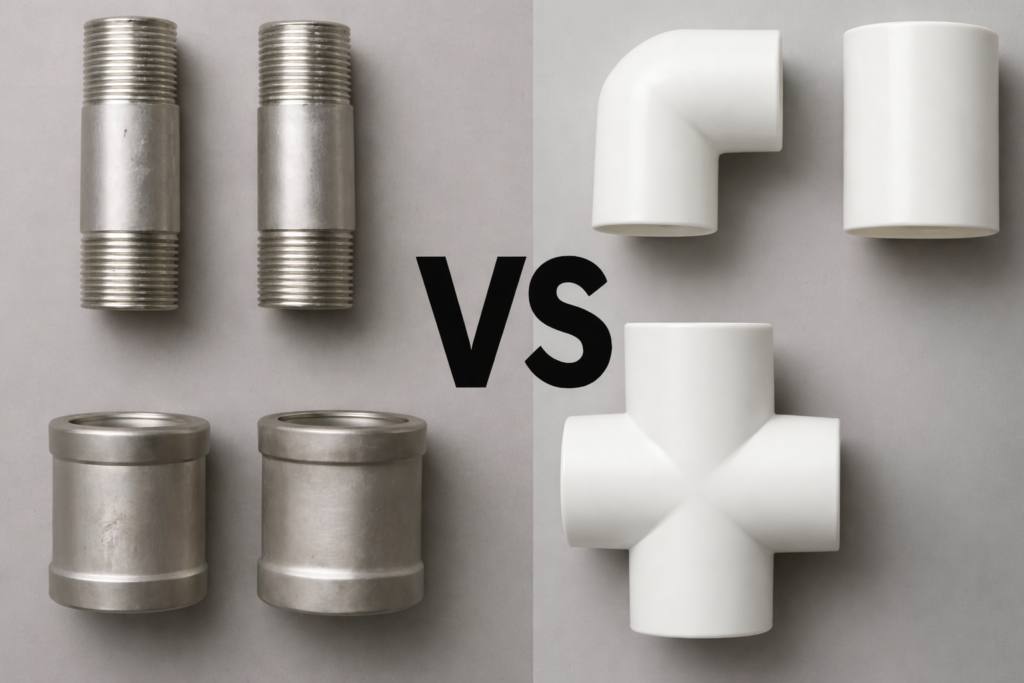
Biggest Stainless Steel Pipe Manufacturers in Ghaziabad? Ghaziabad is a major industrial hub near Delhi, with a long history in steel production. One of the key players in this region is Deal On Steel Industries Pvt. Ltd., a Ghaziabad-based firm specializing in stainless steel (SS) pipes and fittings. Stainless steel pipes themselves are steel alloys containing at least 10.5% chromium, giving them a self-healing chromium-oxide surface that resists rust. This corrosion resistance makes SS pipes ideal for many applications, from industrial fluid transport to plumbing and food processing lines. In this blog, we explore types of SS pipes, popular grades like 304, the role of SS pipe fittings, market pricing, and how Deal On Steel Industries meets Ghaziabad’s stainless steel needs. Stainless Steel Pipes: Types and Applications Stainless steel pipes come in several grades and forms. Austenitic stainless steels such as grades 304 and 316 are most common for pipes. Grade 304 SS (18% Cr, 8% Ni) is a versatile “workhorse” grade – it balances strength, corrosion resistance, and cost. Grade 316 adds molybdenum (Mo) to resist chlorides and harsh chemicals, so it’s often used in marine or chemical-processing environments. In general, a stainless steel pipe’s chromium content produces a thin, self-repairing oxide film that prevents rust. This makes SS pipes last much longer in wet or corrosive conditions than ordinary steel. For instance, Type 304 and 304L stainless steels are widely used for potable water and food/beverage lines. These grades can handle high strength and wide temperature ranges while meeting hygiene standards for plumbing and processing equipment. 304 Stainless Steel Pipe Among SS grades, 304 stainless steel pipe is particularly popular due to its excellent combination of corrosion resistance, weldability, and value. As one supplier notes, “Grade 304 is the trusty, all-around performer” with a broad range of applications. It resists oxidizing acids and performs well for water treatment, plumbing systems, kitchen equipment, and general industrial piping. (It’s also food-safe and meets FDA sanitary regs, making it ideal for food and pharmaceutical lines.) The key trade-off is that 304 can pit in chloride-rich (salty) environments; that’s when higher grades like 316 are preferred. In short, 304 SS pipe offers reliable performance for most projects at a moderate price, which is why it dominates many piping applications Seamless Stainless Steel Pipe SS pipes can be made seamless or welded. A seamless stainless steel pipe is formed from a solid steel billet (no weld line). This construction gives seamless pipes superior integrity: they tolerate higher pressures and avoid weld-related defects or corrosion points. In practice, seamless pipes are often used where strength and purity are critical, such as high-pressure boilers, heat exchangers, or critical fluid lines. Deal On Steel Industries stocks both seamless and welded SS pipes, understanding that project specs dictate the choice. (Typically, seamless SS pipe costs more per meter than the same size of welded pipe, reflecting its manufacturing complexity.) Stainless Steel Pipe Fittings Stainless steel pipe systems also require SS fittings (elbows, tees, reducers, couplings, caps, etc.) made of the same material. These fittings, made from SS alloys with ≥10.5% chromium, ensure the entire assembly resists corrosion. For example, 304-grade SS fittings are common for water or chemical systems because they pair with 304 pipes for full compatibility. In Ghaziabad, Deal On Steel Industries not only supplies pipes but also manufactures and stocks an extensive range of SS pipe fittings in many grades (304, 316, 321, 317L, 310, 347, 904L, etc.). These include elbows, tees, couplings and more, enabling customers to build complete SS piping networks. Stainless Steel vs. Other Fitting Materials: Stainless fittings have clear advantages over alternatives. Because of their chromium content, stainless fittings inherently resist corrosion much better than galvanized steel (which relies on a zinc coating that can wear off). They also outperform copper and PVC in demanding applications. For instance, copper fittings (common in home plumbing) are strong but are prone to corrosion in some water chemistries, whereas stainless steel stays passivated in a wider range of environments. Likewise, PVC (plastic) fittings are cheap and chemical-resistant but cannot handle high pressures or temperatures – stainless steel can. The images below illustrate these contrasts:   Galvanized vs. stainless steel pipe fittings. Unlike galvanized fittings (left) whose zinc coating may rust over time, stainless steel fittings (right) have chromium built in and thus provide superior long-term corrosion resistance Stainless steel vs. PVC fittings. Stainless steel (left) is vastly stronger and tolerates heat/chemicals far beyond PVC (right). PVC is lightweight and cheap but not suitable for high-pressure or high-temp plumbing Stainless Steel Plumbing Fittings For plumbing, SS fittings are prized for hygiene and durability. Grades 304/304L are commonly specified for potable water lines because they do not leach and resist biofilm formation. The comparisons above show that stainless steel plumbing fittings far outlast and outperform galvanized, copper or plastic alternatives in corrosive or industrial water environments. This reliability and long life mean that even though stainless fittings cost more upfront, they often yield lower life-cycle costs in critical systems. In short, wherever clean water or chemicals are transported (in buildings, food plants, hospitals, etc.), SS plumbing fittings are increasingly the material of choice. Stainless Steel Pipe Price and Market Trends For plumbing, SS fittings are prized for hygiene and durability. Grades 304/304L are commonly specified for potable water lines because they do not leach and resist biofilm formation. The comparisons above show that stainless steel plumbing fittings far outlast and outperform galvanized, copper or plastic alternatives in corrosive or industrial water environments. This reliability and long life mean that even though stainless fittings cost more upfront, they often yield lower life-cycle costs in critical systems. In short, wherever clean water or chemicals are transported (in buildings, food plants, hospitals, etc.), SS plumbing fittings are increasingly the material of choice. Deal On Steel Industries–Ghaziabad’s Stainless Steel Pipe Supplier Deal On Steel Industries Pvt. Ltd. is one of Ghaziabad’s prominent stainless steel pipe suppliers and manufacturers. Founded in 2020, it is active in construction-materials distribution and has quickly positioned itself as a “leading provider of high-quality stainless steel pipes in India”. The company maintains a wide

Scroll to Top