
May 19, 2026

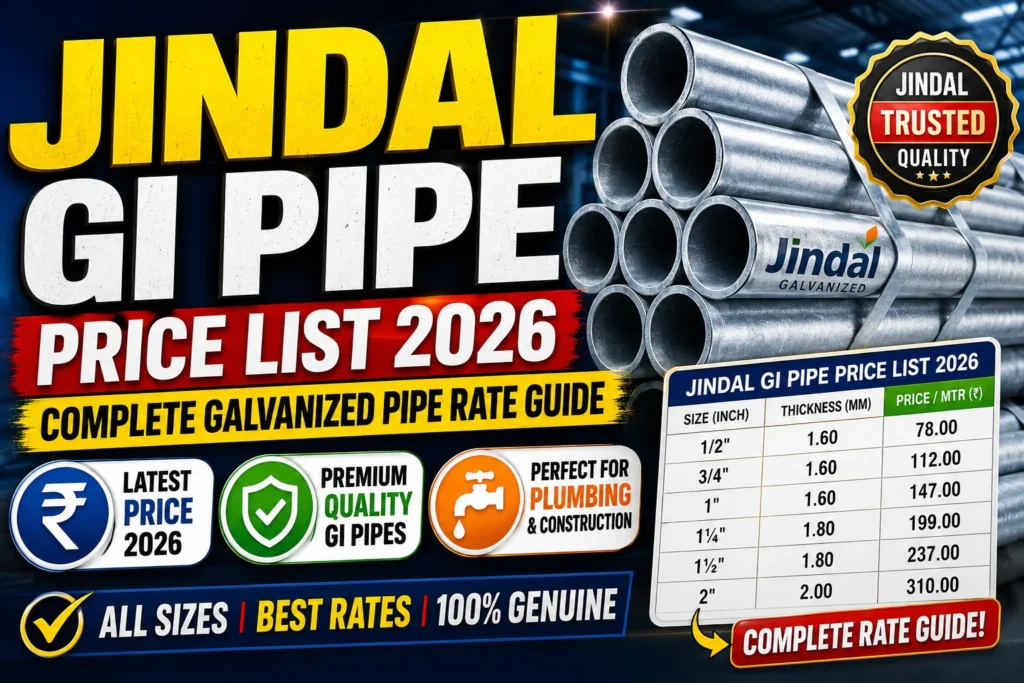
Jindal GI Pipe Price List
Jindal pipes

Jindal GI Pipe Price List 2026 – Complete Galvanized Pipe Rate Guide

Jindal GI Pipe Price List 2026 – Complete Galvanized Pipe Rate Guide Jindal GI pipe prices in India currently start from approximately ₹196 per meter for 15mm light class galvanized pipes and increase depending on pipe size, wall thickness, zinc coating quality, and pressure class. Jindal galvanized iron pipes are widely used in plumbing systems, water supply lines, fire fighting networks, structural fabrication, and industrial piping because of their corrosion resistance and long operational life. In this updated 2026 guide, Deal On Steel Industries provides the latest Jindal GI pipe price list with size-wise rates, GI pipe thickness charts, weight details, industrial specifications, and commercial buying information for contractors, plumbers, fabrication units, EPC companies, and industrial buyers across India. What are Jindal GI Pipes? Jindal GI pipes are galvanized iron pipes manufactured using mild steel and coated with zinc to protect the steel surface from rust and corrosion. These pipes are produced according to IS 1239 standards and are available in Light (A), Medium (B), and Heavy (C) classes. The full form of GI pipe is Galvanized Iron Pipe. Galvanization Process During manufacturing, steel pipes are dipped into molten zinc through a hot-dip galvanization process. This creates a protective zinc coating over the pipe surface that improves corrosion resistance and durability. Why Industries Use GI Pipes Industries prefer Jindal GI pipes because they offer: Excellent corrosion resistance Long service life Smooth internal surface Strong pressure handling capacity Reliable zinc coating Low maintenance Easy installation These pipes are widely used in: Plumbing Water supply Fire fighting systems Industrial piping Structural fabrication Agriculture pipelines Latest Jindal GI Pipe Price List 2026 The following Jindal GI pipe price list is based on current industrial market rates and standard IS 1239 specifications commonly used across plumbing, construction, and fire protection systems in India. The pricing below is aligned with May 2026 market trends and trusted industrial pipe suppliers. NB Size Inch Size Class Thickness Price Per Meter 15 NB 1/2 Inch Light (A) 2.0 mm ₹196 15 NB 1/2 Inch Medium (B) 2.6 mm ₹213 15 NB 1/2 Inch Heavy (C) 3.2 mm ₹241 20 NB 3/4 Inch Light (A) 2.3 mm ₹243 20 NB 3/4 Inch Medium (B) 2.9 mm ₹272 20 NB 3/4 Inch Heavy (C) 3.2 mm ₹296 25 NB 1 Inch Light (A) 2.6 mm ₹324 25 NB 1 Inch Medium (B) 3.2 mm ₹384 25 NB 1 Inch Heavy (C) 4.0 mm ₹451 32 NB 1.25 Inch Light (A) 2.9 mm ₹403 32 NB 1.25 Inch Medium (B) 3.2 mm ₹481 32 NB 1.25 Inch Heavy (C) 4.0 mm ₹577 40 NB 1.5 Inch Light (A) 3.2 mm ₹519 40 NB 1.5 Inch Medium (B) 3.6 mm ₹550 40 NB 1.5 Inch Heavy (C) 4.5 mm ₹657 50 NB 2 Inch Light (A) 3.2 mm ₹643 50 NB 2 Inch Medium (B) 3.6 mm ₹770 50 NB 2 Inch Heavy (C) 4.5 mm ₹918 65 NB 2.5 Inch Medium (B) 4.0 mm ₹1011 65 NB 2.5 Inch Heavy (C) 4.5 mm ₹1197 80 NB 3 Inch Medium (B) 4.5 mm ₹1238 80 NB 3 Inch Heavy (C) 4.8 mm ₹1415 100 NB 4 Inch Medium (B) 4.8 mm ₹1793 100 NB 4 Inch Heavy (C) 5.0 mm ₹2121 Note: GI pipe prices fluctuate according to zinc rates, steel raw material costs, transportation charges, GST, and market demand. Bulk industrial orders may receive quantity discounts. For complete industrial pipe pricing, explore our Jindal Pipes Price List. Jindal GI Pipe Price Per Kg & Per Ton Industrial buyers and fabrication companies often purchase galvanized pipes based on total weight instead of per meter pricing. Product Price Per Kg Price Per Ton Light Class GI Pipe ₹68–₹75 ₹68,000–₹75,000 Medium Class GI Pipe ₹72–₹82 ₹72,000–₹82,000 Heavy Class GI Pipe ₹78–₹90 ₹78,000–₹90,000 Per Meter vs Per Kg Pricing Per meter pricing is commonly used in plumbing projects. Per kg pricing is preferred for industrial procurement. Per ton pricing is useful for large infrastructure projects. Transportation costs are often calculated according to total pipe weight. GI pipe prices per kg also vary according to zinc coating thickness and steel grade. Jindal GI Pipe Thickness Chart GI pipe thickness differs according to pressure class and application requirements. Light Class GI Pipes NB Size Thickness 15 NB 2.0 mm 20 NB 2.3 mm 25 NB 2.6 mm 32 NB 2.9 mm 40 NB 3.2 mm 50 NB 3.2 mm Medium Class GI Pipes NB Size Thickness 15 NB 2.6 mm 20 NB 2.9 mm 25 NB 3.2 mm 32 NB 3.2 mm 40 NB 3.6 mm 50 NB 3.6 mm Heavy (C Class) GI Pipes NB Size Thickness 15 NB 3.2 mm 20 NB 3.2 mm 25 NB 4.0 mm 32 NB 4.0 mm 40 NB 4.5 mm 50 NB 4.5 mm For detailed industrial dimensions and specifications, check our Pipe Thickness Chart. Jindal GI Pipe Weight Chart Pipe Size Weight Per Meter 15 NB 1.27 kg/m 20 NB 1.66 kg/m 25 NB 2.44 kg/m 32 NB 3.14 kg/m 40 NB 3.61 kg/m 50 NB 5.10 kg/m 65 NB 7.14 kg/m 80 NB 8.63 kg/m 100 NB 12.15 kg/m For detailed dimensions and load calculations, check our Jindal Pipe Weight Chart guide. Standard GI Pipe Sizes Available GI pipes are available in various NB sizes for residential, commercial, and industrial applications. NB Size OD Common Applications 15 NB 21.3 mm Household plumbing 20 NB 26.9 mm Water supply 25 NB 33.7 mm Commercial plumbing 32 NB 42.4 mm Fire systems 40 NB 48.3 mm Structural fabrication 50 NB 60.3 mm Industrial piping 80 NB 88.9 mm High-pressure systems 100 NB 114.3 mm Industrial utility lines Standard Lengths Most Jindal GI pipes are supplied in: 6 meter length 5.8 meter commercial length Custom industrial cutting lengths Applications of Jindal GI Pipes Water Supply Systems GI pipes are widely used in municipal and residential water supply systems due to their rust resistance and durability. Plumbing Plumbers use galvanized pipes in bathrooms, kitchens, and building plumbing networks. Fire Fighting
Jindal Pipe Weight Chart 2026
Jindal pipes

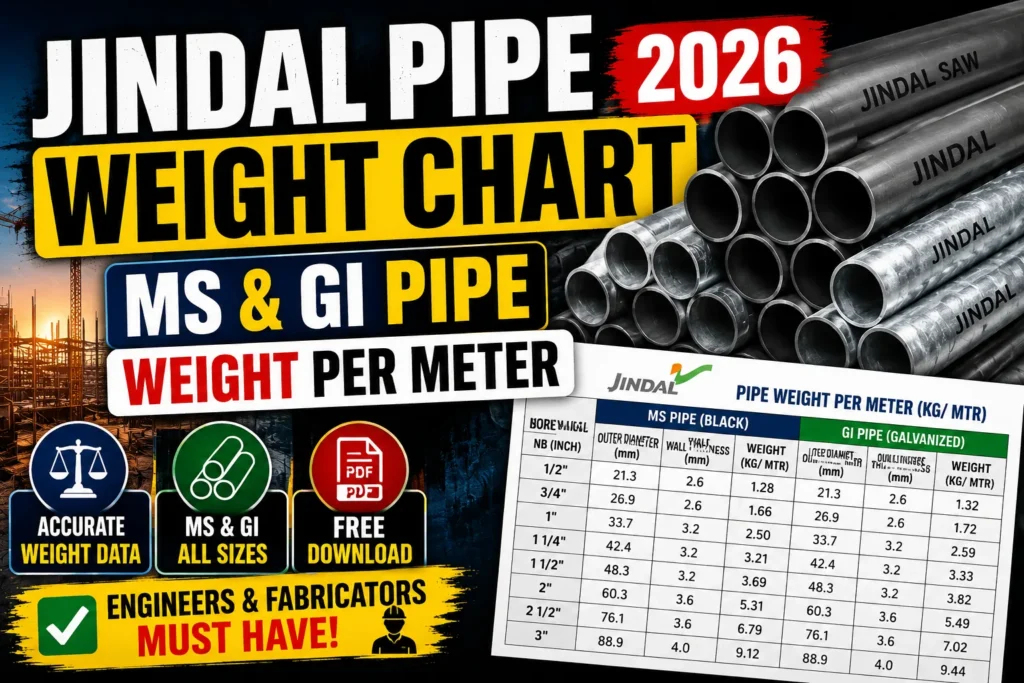
Jindal Pipe Weight Chart 2026 – MS & GI Pipe Weight Per Meter

Jindal Pipe Weight Chart 2026 – Complete MS & GI Pipe Weight Guide Jindal pipe weight charts help contractors, fabricators, EPC companies, and industrial buyers calculate the exact weight of MS and GI pipes per meter for transportation, fabrication, structural load analysis, and project costing. Pipe weight mainly depends on outer diameter (OD), wall thickness, pipe class, and manufacturing standards. In this detailed 2026 guide, Deal On Steel Industries explains the latest Jindal pipe weight chart with standard MS and GI pipe dimensions, thickness charts, IS 1239 classifications, and industrial applications used across construction, plumbing, fabrication, and heavy engineering sectors. Read our full detailed breakdown on the Jindal Pipes price list. What is a Jindal Pipe Weight Chart? A Jindal pipe weight chart is a standardized reference table that shows the theoretical weight of steel pipes based on their size, outer diameter, and wall thickness. These charts are widely used in the steel, construction, plumbing, fabrication, and infrastructure industries. The chart generally includes: NB size (Nominal Bore) Pipe inch size Outer Diameter (OD) Wall thickness Weight per meter Pipe class (Light, Medium, Heavy) Industrial buyers use these charts to estimate: Material consumption Transportation loads Structural weight calculations Fabrication planning Cost estimation Crane lifting requirements Project budgeting For large industrial projects, accurate pipe weight calculations are critical because even small thickness variations can significantly affect total steel tonnage. Deal On Steel Industries supplies Jindal MS and GI pipes with accurate dimensions and standard weight specifications suitable for industrial and commercial projects across India. Jindal Pipe Weight Formula The standard pipe weight formula used in the industry is: Weight (kg/m)=0.02466×(OD−Thickness)×Thicknesstext{Weight (kg/m)} = 0.02466 times (OD – Thickness) times ThicknessWeight (kg/m)=0.02466×(OD−Thickness)×Thickness Understanding the Formula Where: OD = Outer Diameter of Pipe (in mm) Thickness = Wall thickness of pipe (in mm) 0.02466 = Steel density constant Example Calculation Suppose: OD = 60.3 mm Thickness = 3.2 mm Then: Weight = 0.02466 × (60.3 − 3.2) × 3.2= Approx. 4.5 kg/m Theoretical vs Actual Pipe Weight Theoretical pipe weight is calculated mathematically based on standard dimensions. Actual pipe weight may vary slightly due to: Manufacturing tolerances Galvanization coating Material density variations Production standards Industrial projects usually allow a standard tolerance range as per IS standards. Jindal MS & GI Pipe Weight Chart 2026 The following Jindal MS and GI pipe weight chart is based on standard IS 1239 dimensions widely used across construction, plumbing, fire fighting, fabrication, and industrial piping projects in India. NB Size Inch OD (mm) Light Thickness Medium Thickness Heavy Thickness Approx Weight (kg/m) 15 NB 1/2″ 21.3 2.0 2.6 3.2 1.27 – 1.74 20 NB 3/4″ 26.9 2.3 2.6 3.2 1.58 – 2.39 25 NB 1″ 33.7 2.6 3.2 4.0 2.44 – 3.66 32 NB 1 1/4″ 42.4 2.6 3.2 4.0 3.13 – 4.74 40 NB 1 1/2″ 48.3 2.9 3.2 4.0 3.56 – 5.39 50 NB 2″ 60.3 2.9 3.6 4.5 4.49 – 6.72 65 NB 2 1/2″ 76.1 3.2 3.6 4.5 6.18 – 8.83 80 NB 3″ 88.9 3.2 4.0 5.0 7.34 – 11.29 100 NB 4″ 114.3 3.6 4.5 5.4 10.85 – 15.02 125 NB 5″ 140.0 4.0 5.0 5.4 13.42 – 18.24 150 NB 6″ 168.3 4.5 5.0 5.8 18.09 – 23.71 Jindal Pipe Thickness Chart Pipe thickness directly affects: Pressure capacity Structural strength Pipe durability Pipe weight Industrial performance Light Class Pipes Light class pipes are generally used for: Plumbing Water supply Low-pressure applications Residential installations Advantages: Lower cost Easy handling Lightweight structure Medium Class Pipes Medium class pipes are widely used in: Commercial construction Fabrication Structural frameworks Medium-pressure systems These pipes provide balanced strength and cost efficiency. Heavy (C Class) Pipes Heavy class pipes are suitable for: Industrial plants Fire fighting systems High-pressure applications Oil and gas sectors Heavy structural fabrication These pipes have higher wall thickness and better load-bearing capacity. Standard Jindal Pipe Sizes Explained Understanding pipe dimensions is important before selecting industrial pipes. NB (Nominal Bore) NB represents the approximate internal diameter of the pipe. OD (Outer Diameter) OD is the exact external diameter used for weight calculation and fitting compatibility. Schedule Schedule indicates wall thickness level. Higher schedule means thicker pipes. Wall Thickness Wall thickness determines: Strength Pressure handling Pipe weight Durability NB Size OD (mm) Common Use 15 NB 21.3 Household plumbing 25 NB 33.7 Water lines 50 NB 60.3 Structural fabrication 80 NB 88.9 Fire fighting systems 100 NB 114.3 Industrial piping 150 NB 168.3 Heavy industrial projects Jindal GI Pipe Weight Chart GI (Galvanized Iron) pipes include a zinc coating layer that improves corrosion resistance. GI Pipe Size OD (mm) Thickness Approx Weight (kg/m) 15 NB 21.3 2.6 mm 1.58 20 NB 26.9 2.6 mm 1.87 25 NB 33.7 3.2 mm 2.91 40 NB 48.3 3.2 mm 4.47 50 NB 60.3 3.6 mm 5.22 80 NB 88.9 4.0 mm 8.36 100 NB 114.3 4.5 mm 12.48 GI pipes are commonly used in: Plumbing Outdoor piping Water supply systems Agricultural pipelines Fire protection systems Jindal MS Pipe Weight Chart MS pipes are widely used in fabrication and structural applications due to their high weldability and strength. MS Pipe Size OD (mm) Thickness Approx Weight (kg/m) 20 NB 26.9 2.3 mm 1.45 25 NB 33.7 2.6 mm 2.02 40 NB 48.3 2.9 mm 3.35 50 NB 60.3 3.2 mm 4.49 65 NB 76.1 3.6 mm 6.53 80 NB 88.9 4.0 mm 8.36 100 NB 114.3 4.5 mm 12.48 MS pipes are preferred in: Structural fabrication Industrial sheds Machinery manufacturing Steel frameworks Conveyor systems Weight Difference Between Light, Medium & Heavy Class Pipes Pipe Class Thickness Weight Pressure Capacity Common Use Light Lower Lightweight Low Plumbing Medium Moderate Medium Medium Construction Heavy High Heavy High Industrial applications Heavy pipes are more expensive because they use more steel and provide higher durability. How Pipe Weight Affects Project Cost Pipe weight plays a major role in industrial project costing. Transportation Cost Heavier pipes increase: Truck load cost Fuel expenses Crane unloading charges Fabrication Cost Higher weight affects: Welding time Cutting cost Labor handling Structural

Scroll to Top