MS Pipe Sizes in MM, Inches & NB: Complete Size Chart Guide 2026
MS pipe sizes are measured in MM, inches, and NB (Nominal Bore) standards for industrial, commercial, and construction applications. Choosing the correct pipe size is important for strength, load capacity, fluid flow, and project safety. Trusted suppliers like Deal On Steel Industries help B2B buyers select accurate MS pipe sizes for every application.
-
MS Pipe Sizes in MM, Inches & NB: Complete Size Chart Guide 2026
- Introduction
- What Are MS Pipes?
- Understanding Mild Steel Pipes
- Why Pipe Size Matters in Industrial Projects
- Understanding Pipe Size Terminology
- MS Pipe Sizes in MM
- Standard Pipe Sizes in Millimeters
- MS Pipe Sizes in Inches
- Common Pipe Sizes in Inches
- MS Pipe NB Size Chart
- Common NB Sizes Used in India
- Types of MS Pipes Based on Shape
- Standard Pipe Thickness in India
- How to Choose the Correct MS Pipe Size
- Understand the Project Requirement
- Common Industries Using Different MS Pipe Sizes
- Common Mistakes Buyers Make While Choosing Pipe Sizes
- Importance of Pipe Weight in Industrial Procurement
- Latest MS Pipe Market Trends in 2026
- How Reliable Suppliers Help B2B Buyers
- Tips for Buying MS Pipes in 2026
- Future of MS Pipe Industry in India
- Conclusion
- FAQs
- Best MS Pipe Brands in India 2026: Top Companies for Quality Steel Pipes
- MS Black Pipe Price in India 2026: Latest Rates Per Kg, Sizes & B2B Buying Guide
- MS Pipe Sizes in MM, Inches & NB: Complete Size Chart Guide 2026
- Welded Pipes vs MS Black Pipes: Which Steel Pipe is Better for Construction in 2026?
- APL Apollo MS Black Pipe Price in Ghaziabad (2026): Latest Rates, Sizes & B2B Buying Guide
- MS Pipe Dealers in Ghaziabad (2026) | Complete B2B Buying Guide for Quality MS Pipes, Prices & Trusted Supplier
- MS Pipe Weight Calculator (2026) Calculate MS Pipe Weight Per Meter & Per Feet
- MS ERW Pipes vs Seamless Pipes in 2026: Complete Difference, Price, Strength & Best Choice for B2B Buyers
Steel prices continue to fluctuate in 2026 due to changing raw material and transportation costs. Check the latest MS Black Pipe Price in India 2026 before placing your next bulk industrial order.
Introduction
If you have ever purchased MS pipes for a construction project, factory setup, warehouse structure, or fabrication work, you already know one thing — pipe sizing can get confusing very quickly.
Some suppliers mention sizes in inches. Others use millimeters. Many industrial buyers talk in NB sizes. Then there are wall thickness standards, OD measurements, and weight calculations. For a new buyer, this can feel overwhelming.
But here is the reality.
Selecting the wrong MS pipe size can directly affect:
- Structural strength
- Material cost
- Fabrication quality
- Transportation expense
- Load-bearing capacity
- Overall project safety
That is why understanding MS pipe sizes in MM, inches & NB has become extremely important for contractors, engineers, procurement teams, and industrial buyers in 2026.
In this detailed guide, we will explain everything in simple English — from pipe size charts to thickness standards, industrial applications, selection methods, and common mistakes buyers should avoid. You can also check our full MS pipe latest rates
What Are MS Pipes?
Understanding Mild Steel Pipes
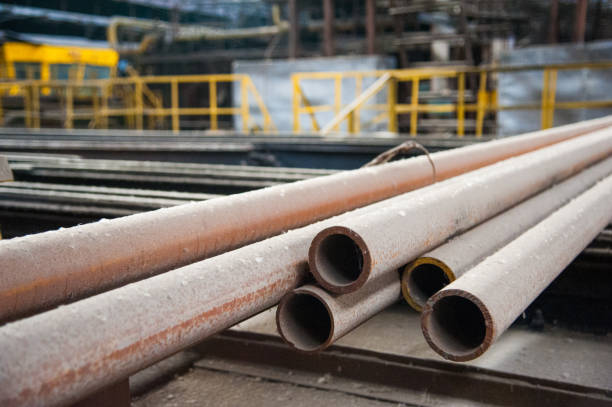
MS pipes, also called Mild Steel pipes, are steel pipes manufactured using low carbon steel. These pipes are widely used because they are:
- Strong
- Durable
- Easy to fabricate
- Cost-effective
- Easily available
MS pipes are commonly used in:
- Construction projects
- Industrial fabrication
- Warehouses
- Scaffolding
- Water pipelines
- Solar structures
- Engineering industries
Today, MS pipes are one of the most demanded steel products in India’s infrastructure and industrial sectors.
Why Pipe Size Matters in Industrial Projects
Pipe Size Directly Affects Performance
Many buyers think all MS pipes perform similarly. That is not true.
Pipe size determines:
- Pressure handling capacity
- Structural strength
- Weight
- Flow efficiency
- Welding performance
- Load distribution
For example, a small-diameter pipe may work perfectly for railings or light fabrication. But the same pipe may completely fail in a warehouse structure or industrial support system.
This is why professional suppliers like Deal On Steel Industries guide buyers carefully before finalizing pipe dimensions.
Understanding Pipe Size Terminology
What Is NB in MS Pipes?
NB stands for Nominal Bore.
This is one of the most commonly used sizing standards in the Indian pipe industry.
NB refers to the approximate internal diameter of the pipe.
Examples:
- 15 NB pipe
- 20 NB pipe
- 25 NB pipe
- 50 NB pipe
- 100 NB pipe
Many industrial buyers and fabricators use NB terminology during procurement because it is an industry-standard measurement system.
What Is OD in Pipes?
OD means Outer Diameter.
This refers to the external diameter of the pipe.
OD is important because:
- Pipe fittings depend on OD
- Welding compatibility depends on OD
- Structural calculations depend on OD
Even if two pipes have different wall thicknesses, their OD may remain the same.
What Is Pipe Thickness?
Pipe thickness refers to the wall thickness of the pipe.
Thickness affects:
- Pipe weight
- Pipe strength
- Pressure capacity
- Durability
A thicker pipe will naturally:
- Carry more load
- Handle higher pressure
- Weigh more
- Cost more
MS Pipe Sizes in MM
Standard Pipe Sizes in Millimeters
In India, many buyers prefer pipe sizes in MM because it simplifies industrial calculations.
Some common MS pipe sizes in MM include:
- 15 mm
- 20 mm
- 25 mm
- 32 mm
- 40 mm
- 50 mm
- 65 mm
- 80 mm
- 100 mm
These sizes are widely used in commercial construction, engineering, and industrial projects.
MS Pipe Sizes in Inches
Common Pipe Sizes in Inches
Inches are still heavily used in the steel and piping industry.
Here are some standard pipe sizes:
- ½ inch
- ¾ inch
- 1 inch
- 1.5 inch
- 2 inch
- 3 inch
- 4 inch
- 6 inch
Fabricators and contractors often use inch terminology while discussing pipe requirements on-site.
MS Pipe NB Size Chart
Common NB Sizes Used in India
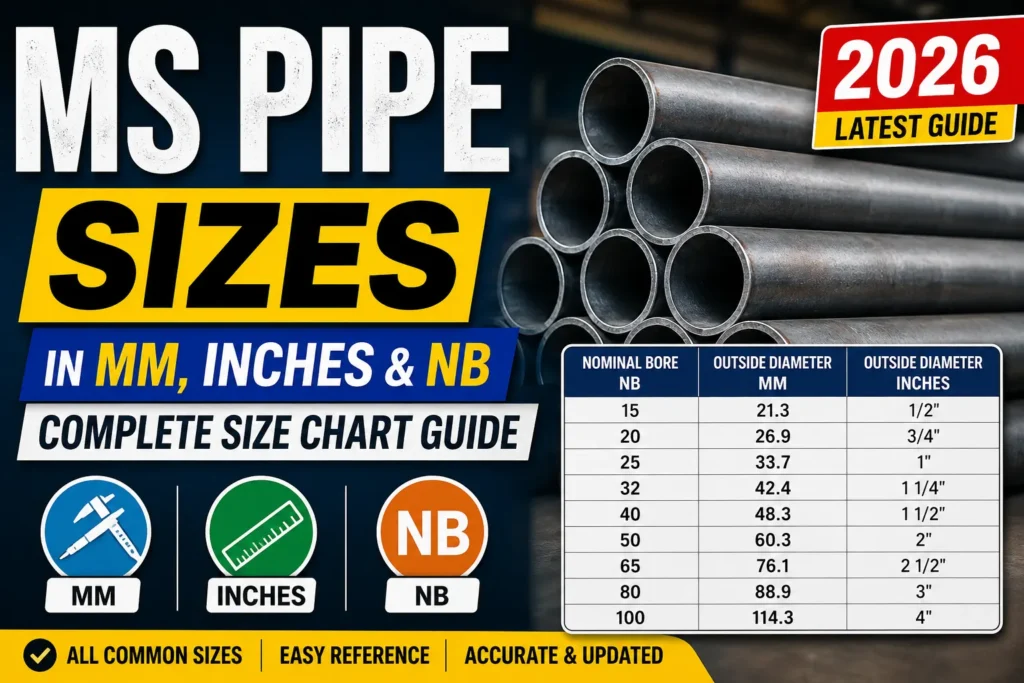
| NB Size | Approx Inch Size |
|---|---|
| 15 NB | ½ inch |
| 20 NB | ¾ inch |
| 25 NB | 1 inch |
| 32 NB | 1¼ inch |
| 40 NB | 1½ inch |
| 50 NB | 2 inch |
| 65 NB | 2½ inch |
| 80 NB | 3 inch |
| 100 NB | 4 inch |
Understanding these conversions helps buyers communicate more accurately with suppliers and fabricators.
Types of MS Pipes Based on Shape
Round MS Pipes
Round pipes are the most common type of MS pipes.
Applications include:
- Water transportation
- Scaffolding
- Industrial fabrication
- Structural supports
- Engineering applications
Round pipes are available in multiple diameters and thickness ranges.
Square MS Pipes
Square pipes are widely used for:
- Gates
- Railings
- Furniture
- Decorative fabrication
- Steel structures
Their symmetrical design provides better appearance and structural stability.
Rectangular Hollow Sections
Rectangular pipes are commonly used in:
- Warehouse construction
- Industrial sheds
- Solar structures
- Commercial fabrication
These pipes provide excellent load distribution.
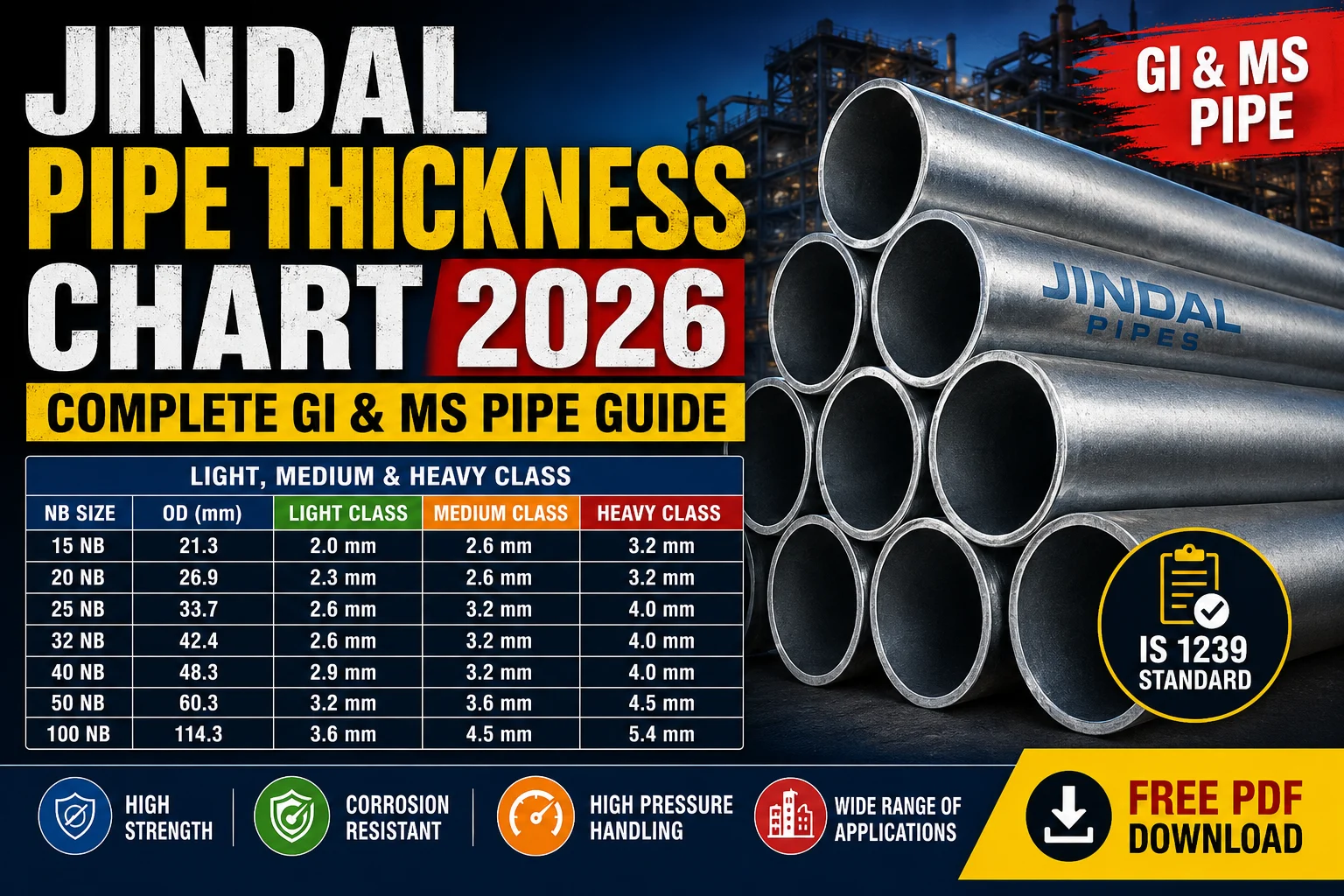
Standard Pipe Thickness in India
MS pipes are usually available in:
Light Class Pipes
Used for:
- Furniture
- Light fabrication
- Decorative work
Medium Class Pipes
Used for:
- Commercial construction
- Structural applications
- General industrial work
Heavy Class Pipes
Used for:
- Industrial projects
- Heavy engineering
- Infrastructure structures
The thicker the pipe, the greater its strength and weight.
How to Choose the Correct MS Pipe Size
Understand the Project Requirement
Before selecting any pipe size, ask:
- Will the pipe carry load?
- Will fluid pass through it?
- Is the pipe for structural support?
- Is it indoor or outdoor usage?
These factors determine the correct size and thickness.
Choosing the right pipe brand is extremely important for long-term durability and structural performance. Explore our detailed guide on the Best MS Pipe Brands in India 2026 before purchasing material for your next project.
Check Load Capacity
A warehouse structure requires thicker and stronger pipes than decorative railings.
Always match pipe dimensions with engineering requirements.
Consider Transportation Costs
Larger and heavier pipes increase:
- Freight costs
- Handling expenses
- Storage space
Smart procurement teams balance strength and cost efficiency together.
Common Industries Using Different MS Pipe Sizes
Construction Industry
Construction companies use different pipe sizes for:
- Scaffolding
- Structural columns
- Roofing structures
- Boundary fencing
Fabrication Industry
Fabricators use pipes for:
- Gates
- Furniture
- Frames
- Decorative applications
Industrial Manufacturing
Factories use MS pipes in:
- Machinery frames
- Conveyor systems
- Industrial supports
Agriculture Sector
Agriculture applications include:
- Bore systems
- Irrigation pipelines
- Greenhouse structures
Common Mistakes Buyers Make While Choosing Pipe Sizes
Ignoring Thickness
Some buyers only compare diameter and ignore wall thickness.
This creates problems like:
- Structural failure
- Pipe bending
- Welding weakness
Buying Only Based on Lowest Price
Cheaper pipes may be:
- Underweight
- Low-grade
- Non-standard
Always compare specifications properly.
Not Verifying Pipe Weight
Professional buyers should always verify:
- Weight per meter
- Thickness
- Pipe dimensions
Many procurement teams now use an MS Pipe Weight Calculator before placing bulk orders to avoid estimation errors.
Importance of Pipe Weight in Industrial Procurement
Weight Directly Impacts Cost
Pipe pricing depends heavily on weight.
Heavier pipes cost more because they contain more steel.
Weight also affects:
- Transportation charges
- Loading cost
- Structural calculations
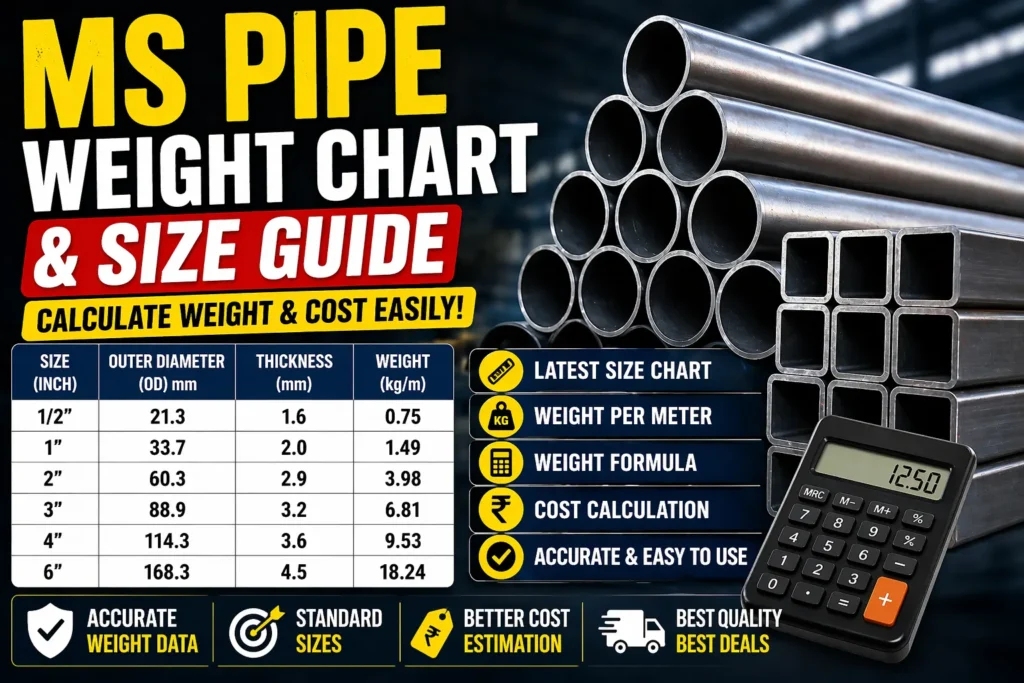
This is why many buyers refer to an MS Pipe Weight Chart & Size Guide 2026 before purchasing.
Latest MS Pipe Market Trends in 2026
Growing Demand for Structural Pipes
India’s infrastructure growth is increasing demand for:
- Warehouses
- Commercial buildings
- Solar projects
- Industrial sheds
- Logistics parks
Because of this, MS pipe demand continues to rise rapidly.
Preference for Branded Pipes
Many B2B buyers now prefer branded pipes because they offer:
- Better thickness accuracy
- Consistent weight
- Better finish
- Reduced rejection risk
How Reliable Suppliers Help B2B Buyers
Importance of Experienced Pipe Suppliers
A professional supplier does more than just sell pipes.
They help buyers with:
- Size selection
- Thickness recommendations
- Weight verification
- Bulk supply management
- Logistics support
This is why many contractors and industrial buyers prefer working with experienced suppliers like Deal On Steel Industries for long-term procurement support.
Tips for Buying MS Pipes in 2026
Verify Standard Specifications
Always ask for:
- ISI standards
- GST invoices
- Weight verification
- Thickness details
Compare Pipe Weight Carefully
Never compare only piece rates.
Always compare:
- Weight per meter
- Thickness
- Material grade
Buy According to Actual Usage
Do not overbuy heavy pipes unnecessarily.
Similarly, avoid using lightweight pipes for heavy structures.
Proper selection saves money and improves safety.
Future of MS Pipe Industry in India
Strong Growth Expected Beyond 2026
India’s industrial and infrastructure sectors continue to expand rapidly.
Demand is increasing in:
- Smart city projects
- Warehousing
- Renewable energy
- Commercial construction
- Industrial corridors
Because of this, the MS pipe industry is expected to grow strongly over the next few years.
Conclusion
Understanding MS pipe sizes in MM, inches & NB is extremely important for contractors, fabricators, industrial buyers, and infrastructure companies in 2026.
Choosing the correct pipe size improves:
- Structural safety
- Cost efficiency
- Project performance
- Procurement accuracy
Whether you are purchasing pipes for fabrication, warehouses, industrial projects, or infrastructure work, always verify pipe dimensions, thickness, and weight before placing an order.
Reliable suppliers like Deal On Steel Industries help buyers select the right MS pipe sizes with proper industrial guidance, consistent stock availability, and dependable supply support across projects.
FAQs
What is NB size in MS pipes?
NB stands for Nominal Bore, which refers to the approximate internal diameter of the pipe used in industrial sizing standards.
Which MS pipe size is most commonly used?
Commonly used sizes include 15 NB, 20 NB, 25 NB, 50 NB, and 100 NB pipes for construction and industrial applications.
Why is pipe thickness important?
Pipe thickness affects strength, weight, pressure capacity, and durability.
How are MS pipe sizes measured?
MS pipe sizes are measured using MM, inches, OD (Outer Diameter), and NB standards.
Why do industrial buyers verify pipe weight?
Weight verification helps buyers avoid underweight material and ensures proper structural calculations and pricing accuracy.
About Company
Deal On Steel Industries Pvt. Ltd. has established itself as a leading provider of high-quality stainless steel pipes in India. We are dedicated to exceeding client expectations by delivering superior products, believing this is the definitive path to success.
Most Recent Posts
- All Posts
- Boiler tubes
- Jindal pipes
- Kolkata
- mild Steel
- Ms erw Pipes
- MS Pipes
- Seamless Boiler Tubes
- Stainless Steel Coils
- stainless steel fittings
- Stainless steel Flanges
- Stainless Steel Pipes
- Stainless steel sheets
- Stainless steel Tubes
- Steel Prices
- Trending Steel
- Back
- Alloy Steel Boiler Tubes
- Carbon Steel Boiler Tubes
- Stainless Steel Boiler Tubes
- Jindal Boiler Tubes
- TATA Boiler Tubes
- ERW Boiler Tubes
- Back
- TATA Boiler tubes