Steel Price Trend in India (2020–2026): Full Data Analysis
Steel prices in India have seen major fluctuations from 2020 to 2026 due to COVID-19 disruptions, rising raw material costs, strong infrastructure demand, and global market shifts. Prices dropped sharply in 2020, surged in 2021–2022, stabilized in 2023, and are rising again in 2025–2026.
Introduction
Steel is one of the most important materials in construction, infrastructure, and manufacturing. From residential buildings to large-scale industrial projects, steel plays a key role in shaping modern India. Over the past few years, steel prices in India have not remained stable. Instead, they have followed a pattern of sharp rises and falls influenced by global events, domestic demand, and raw material costs. For buyers, contractors, and businesses, understanding these trends is critical. It helps in making better purchasing decisions, managing budgets, and avoiding losses. In this detailed guide by Deal On Steel Industries, we will break down the steel price trend in India from 2020 to 2026 using simple explanations and real market insights.
If you want a complete breakdown of why prices are increasing right now, you can also read our main guide:
👉 Why Steel Prices Are Increasing in 2026? Complete Market Breakdown for Buyers
Steel Price Trend Chart in India (2020–2026)
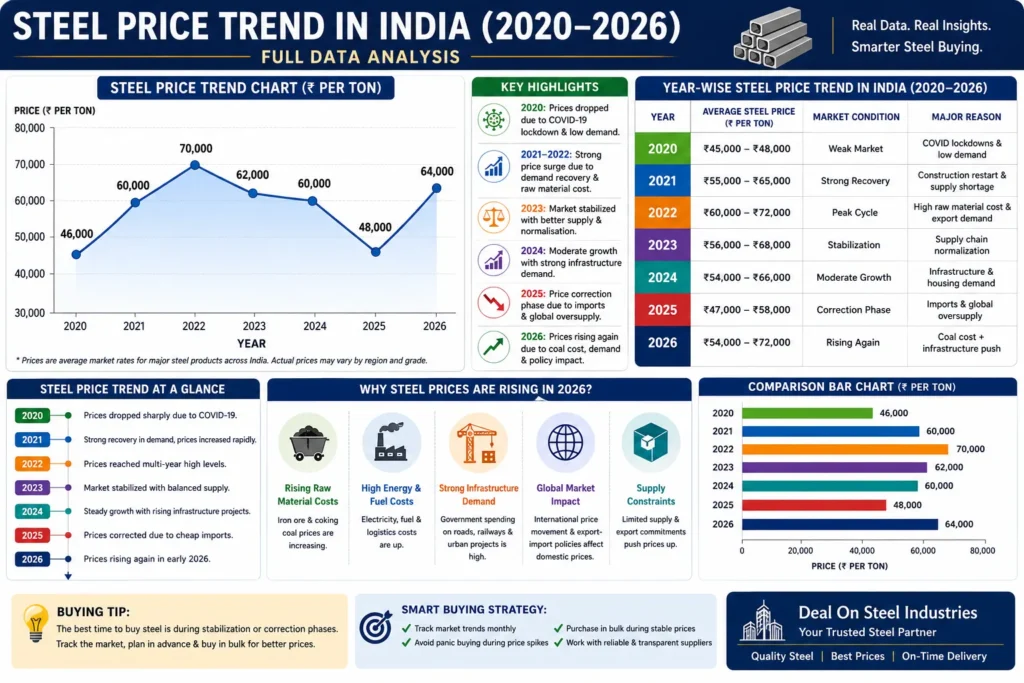
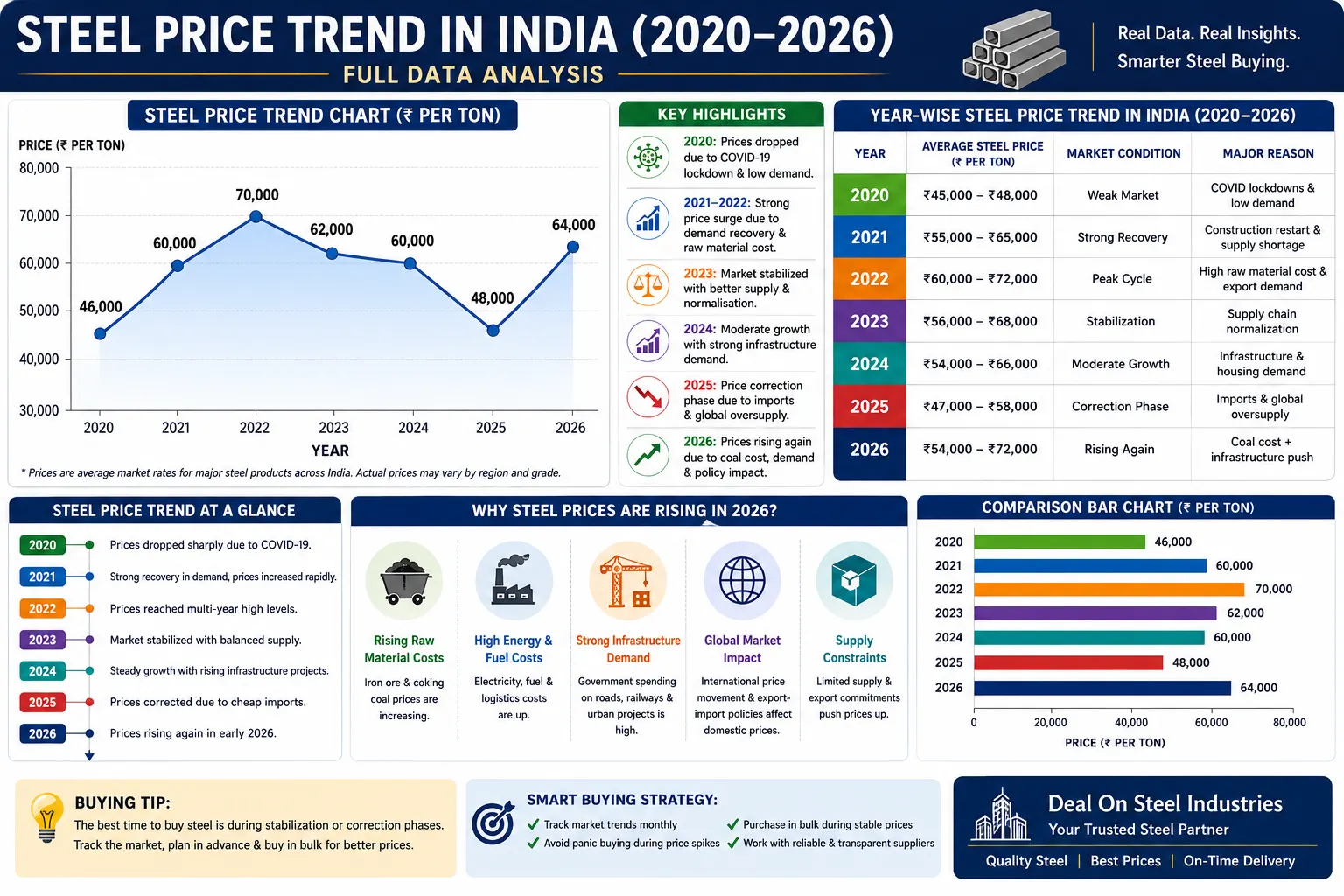
Below is a realistic market trend chart based on industry reports, wholesale market data, infrastructure demand trends, and steel pricing movement across India.
| Year | Average Steel Price (₹ per Ton) | Market Condition | Major Reason |
|---|
| 2020 | ₹45,000 – ₹48,000 | Weak Market | COVID lockdowns & low demand |
| 2021 | ₹55,000 – ₹65,000 | Strong Recovery | Construction restart & supply shortage |
| 2022 | ₹60,000 – ₹72,000 | Peak Cycle | High raw material cost & export demand |
| 2023 | ₹56,000 – ₹68,000 | Stabilization | Supply chain normalization |
| 2024 | ₹54,000 – ₹66,000 | Moderate Growth | Infrastructure & housing demand |
| 2025 | ₹47,000 – ₹58,000 | Correction Phase | Imports & global oversupply |
| 2026 | ₹54,000 – ₹72,000 | Rising Again | Coal cost + infrastructure push |
The above trend is based on market reports and pricing movement from Indian steel hubs.
Steel Price Trend in India (2020–2026)
Let’s understand how steel prices have moved year by year.
2020 – The COVID Crash Phase
The year 2020 was one of the most challenging periods for the global economy due to the outbreak of COVID-19.
- Nationwide lockdowns stopped construction activities
- Factories and manufacturing units were shut
- Demand for steel dropped significantly
Price Trend:
Steel prices fell sharply during the first half of 2020. Many suppliers faced losses due to low demand.
However, toward the end of 2020, prices started recovering as economic activity slowly resumed.
2021 – Strong Recovery and Demand Surge
2021 marked a strong comeback for the steel industry.
- Construction projects restarted
- Government pushed infrastructure development
- Demand increased faster than supply
Price Trend:
Steel prices increased rapidly, sometimes reaching record highs.
This sudden increase caught many buyers off guard, especially those who were expecting prices to remain low after 2020.
2022 – Peak Price Levels
In 2022, steel prices reached one of their highest levels in recent years.
Key reasons:
- High global demand
- Supply chain disruptions
- Rising cost of raw materials like iron ore and coal
Price Trend:
Prices remained high for most of the year, with slight fluctuations.
This period created pressure on construction costs and project budgets.
2023 – Market Stabilization Phase
After two years of high volatility, 2023 brought some stability.
- Supply chains improved
- Production levels normalized
- Demand became more predictable
Price Trend:
Steel prices corrected slightly and remained relatively stable compared to previous years.
This was considered a “balancing year” for the industry.
2024 – Moderate Growth
In 2024, the market showed steady growth.
- Infrastructure projects increased
- Real estate demand improved
- Industrial production expanded
Price Trend:
Prices moved upward gradually, but without extreme spikes.
Buyers found this year relatively easier to plan purchases.
2025 – Rising Pressure Begins
In 2025, signs of price increase became more visible.
- Raw material costs started rising again
- Global demand increased
- Energy costs went up
Price Trend:
Steel prices began climbing steadily, signaling another upward cycle.
2026 – Renewed Price Surge
In 2026, steel prices are again rising significantly.
Major factors:
- Expensive iron ore and coal
- High transportation costs
- Strong infrastructure demand in India
- Global market pressure
Price Trend:
Prices are on an upward trend, making it important for buyers to plan purchases carefully.
For deeper insights, read:
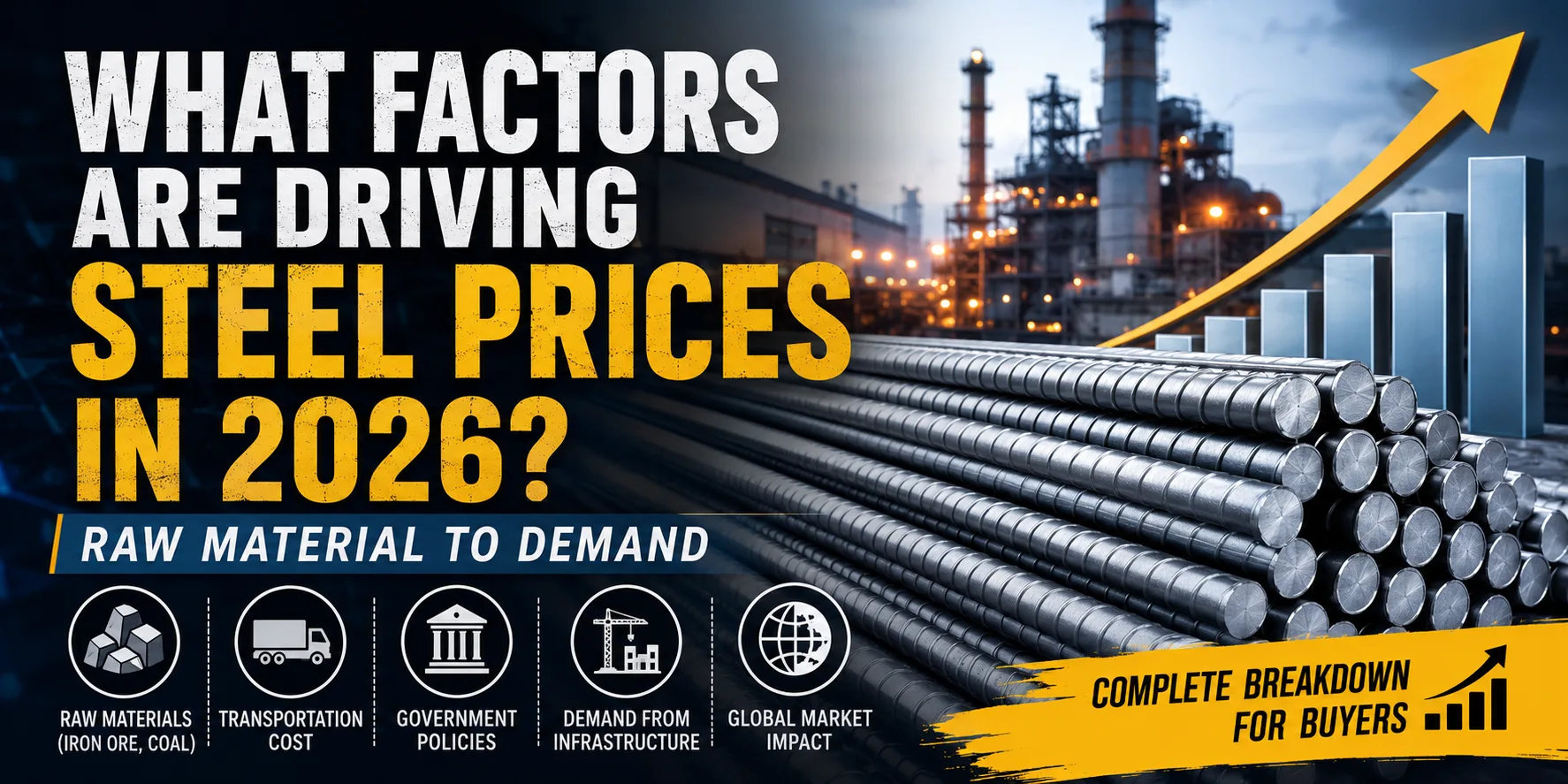
👉 What Factors Are Driving Steel Prices in 2026?
👉 Steel Price Forecast 2026–2027: Should You Buy Now or Wait?
Impact of COVID-19 on Steel Prices
The biggest turning point in recent steel price history was the COVID-19 pandemic.
Demand Shock
During lockdowns:
- Construction projects stopped
- Manufacturing demand dropped
- Steel consumption reduced drastically
This caused prices to fall sharply.
Supply Chain Disruption
At the same time:
- Transport restrictions affected supply
- Labor shortages reduced production
- Imports and exports were impacted
Recovery Phase
Once restrictions were lifted:
- Demand returned suddenly
- Supply could not keep up
This mismatch caused prices to rise rapidly in 2021.
Post-2023 Growth Phase
After stabilization in 2023, the steel market entered a structured growth phase.
Infrastructure Boom in India
The Indian government increased spending on:
- Highways
- Railways
- Smart cities
- Industrial corridors
This created consistent demand for steel.
Real Estate Recovery
- Housing demand increased
- Commercial construction resumed
- Urban expansion continued
Industrial Growth
- Manufacturing sector expanded
- Engineering and fabrication industries grew
All these factors supported steady steel demand.
Reasons Behind Steel Price Spike (2025–2026)
The current rise in steel prices is not random. It is driven by multiple strong factors.
1. Rising Raw Material Costs
Steel production depends heavily on:
When these become expensive, steel prices automatically increase.
2. High Energy and Fuel Costs
Steel manufacturing is energy-intensive.
- Electricity costs increased
- Fuel prices went up
- Logistics became expensive
3. Strong Demand from Infrastructure
India is investing heavily in infrastructure, which requires massive amounts of steel.
This keeps demand consistently high.
4. Global Market Influence
India is not isolated from the global market.
- Changes in international prices affect domestic rates
- Export-import policies influence supply
To understand this better, read:
👉 How Global Market Affects Steel Prices in India (2026 Explained)
5. Supply Constraints
- Limited production capacity in some regions
- Logistics challenges
- Export commitments
These factors reduce local availability and push prices higher.
Steel Price Trend Chart (2020–2026)
Below is a simplified representation of how steel prices have moved:
| Year | Market Trend | Price Movement |
|---|
| 2020 | COVID Impact | Sharp Drop |
| 2021 | Recovery | Rapid Increase |
| 2022 | Peak | Very High |
| 2023 | Stabilization | Slight Correction |
| 2024 | Growth | Moderate Increase |
| 2025 | Pressure | Rising |
| 2026 | Surge | High Increase |
This trend clearly shows that steel prices follow cycles influenced by both demand and external factors.
What This Means for Buyers
Understanding price trends helps buyers make smarter decisions.
Plan Purchases in Advance
Avoid buying during peak price periods.
Track Market Trends
Regularly monitor price movements and news.
Buy in Bulk When Prices Are Stable
This helps reduce overall cost.
Work with Reliable Suppliers
Choosing trusted suppliers like Deal On Steel Industries ensures:
- Transparent pricing
- Quality materials
- Market insights
Conclusion
The steel price trend in India from 2020 to 2026 shows a clear pattern of disruption, recovery, stabilization, and growth. The COVID-19 pandemic caused a sharp fall, followed by a strong recovery and rising demand.
In 2026, prices are increasing again due to raw material costs, infrastructure demand, and global market factors.
For buyers, the key is to stay informed and plan purchases strategically.
To understand the complete reason behind the current price rise, don’t forget to read our main guide:
👉 Why Steel Prices Are Increasing in 2026? Complete Market Breakdown for Buyers